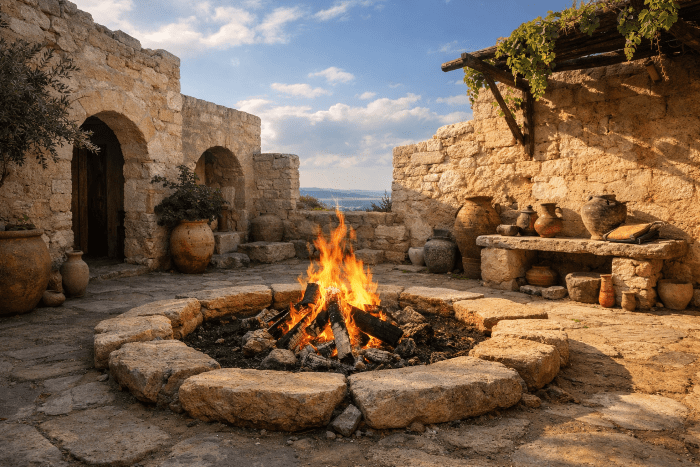
A post–Mother’s Day reflection on the ancient roots of Hearth Mysticism
Before there were doctors, midwives, herbalists, or healers with formal titles, there was the hearthkeeper (most often a woman) — the person who tended the fire, the food, the warmth, the rhythms, and the emotional climate of the home. Long before medicine became a profession, healing lived in the domestic sphere, woven into the daily movements of ordinary life.
This was the earliest form of preventative medicine, emotional regulation, and community stability. Women most often kept the interior fires and men often managed outdoor (communal and ritual) fires.
Anthropologists call the woman’s role domestic medicine: the practical, observational, home‑based care that sustained families and communities for thousands of years. But what often goes unnamed is the deeper truth — that tending the home was also humanity’s first spiritual practice.
The hearthkeeper was maintaining the continuity of life.
The Home as the First Healing Space
In early human societies, survival and spirituality were interwoven.
The home was the center of:
- warmth
- nourishment
- rest
- recovery
- emotional steadiness
- ritual continuity
The person who tended the hearth naturally became the one who:
- monitored the health of family members
- prepared medicinal foods
- controlled warmth and rest
- maintained cleanliness to prevent illness
- stabilized the emotional climate through order and rhythm
These responsibilities were understood as life‑preserving acts, essential to the wellbeing of the entire household.
Across cultures — from the Greek Hestia to the Roman Vesta, from Celtic Brigid to the household spirits of Slavic and East Asian traditions — the hearthkeeper was recognized as the spiritual center of the home.
Mysticism Was Not a Luxury
Modern people often imagine that ancient life left no room for mysticism. But this is a misunderstanding born of our own fragmented world.
For early humans:
- tending the fire
- preparing food
- maintaining order
- creating warmth
- observing illness
…were not separate from meaning, ritual, or cosmology. Mysticism wasn’t something just pondered; it was something lived.
The hearthkeeper was an embodiment of spirituality. Their daily movements were the rituals that kept the world intact by maintaining the boundary between chaos and order, by sustaining continuity and regulating the emotional field, and by tending the fire that symbolized life itself.
But most of all, the home was the world. It was the hospital, the temple, the school, the emotional center, the economic unit, the spiritual field…
And it still is, when we let it be what it was always meant to be.
Hearth Mysticism as a Revival
This is why Hearth Mysticism feels both ancient and strangely familiar. It is not a modern metaphysical system layered onto domestic life. It is a revival of the oldest healing tradition humanity has ever known.
Hearth Mysticism restores the unity that ancient people never lost:
- the home as healer
- the environment as medicine
- the atmosphere as emotional regulator
- the daily rhythms as spiritual practice
- the hearthkeeper as the quiet center of continuity
Repeating daily rhythms was the original form of spiritual practice. It was the way ancient people created stability, deep meaning, and continuity through ordinary acts.
The home is a living field, and tending it reaches far beyond the physical.
A Post–Mother’s‑Day Reflection
As we move through the days following Mother’s Day, it feels right to honor the lineage of those who tended homes long before the word “mother” meant what it does now — the ancestors who kept fires alive, who nourished communities, who practiced the earliest forms of healing without ever calling themselves healers.
Their work is the foundation of Hearth Mysticism. Their legacy is alive in every home that seeks harmony, steadiness, and renewal.
And if you’d like to explore the anthropological roots of this lineage more deeply, you can read The Anthropological Roots of the Hearth Steward.


Leave a comment