Prepping is typically thoughtful, organized, and open-hearted.
Hoarding is where mental habits become unnecessary accumulation for accumulation’s sake. It is often disorganized and can become outright disastrous, beginning as boxes and piles in corners and against walls. In time, they can grow higher and wider, even making navigating from one room to another a task to be reckoned with. And what is hoarded can typically be perceived, in most cases, as junk to anyone else.
Some people, however, collect practical things because “you never know when it’ll be needed.” It’s what I consider a middle-ground where one can go either way. I consider “survival hoarding” to be fear-based, and prepping to be more open-hearted.
Those with a hoarding disorder around survival are the kind of people who, in an apocalypse, would bolt their doors, board their windows, monitor their cameras and not open the door for anyone. Their stuff is their stuff. They worked hard for it and it might last them their entire lifetime behind closed doors. But this is not a healthy way to survive, and it (for me personally) would hardly be worth living at that point.
I went to AI for a table of what prepping versus hoarding looks like, and I’ll share “her” version, although I don’t agree with everything and will explain momentarily.
🧭 Hoarding vs. Prepping: A Comparative Table
| Aspect | Hoarding | Prepping |
|---|---|---|
| Core Intent | Driven by fear, scarcity, or compulsion | Rooted in foresight, resilience, and stewardship |
| Emotional Ecology | Often chaotic, anxious, or reactive | Grounded, strategic, and calming |
| Volume of Supplies | Excessive, often without clear use or rotation | Thoughtful quantities based on realistic needs and timelines |
| Storage Style | Disorganized, hidden, or overwhelming | Organized, labeled, and accessible |
| Use Cycle | Items may expire or go unused | Supplies are rotated, refreshed, and integrated into daily life |
| Impact on Others | Can contribute to community scarcity or relational strain | Often includes community care, sharing, or mutual aid |
| Relationship to Space | Cluttered, congested, or emotionally heavy | Spacious, intentional, and sanctuary-oriented |
| Psychological Drivers | Trauma response, control issues, or unresolved grief | Empowerment, preparedness, and ecological awareness |
| Examples | Stockpiling 200 cans of soup with no plan to eat them | Keeping 30 cans, rotating them monthly, and sharing extras with neighbors |
| Civic Resonance | May strain local systems or emergency response | Supports local resilience and reduces burden on public infrastructure |
| Metaphorical Lens | Emotional congestion, fear-based accumulation | Threshold tending, sacred stewardship, and metabolic foresight |
I feel that this is an excellent summary, but I disagree with the quantities in AI’s examples (as long as consumption is part of the plan). Having been raised LDS (Mormon), as mentioned in a recent post, I learned the value, the security, of having a year or two’s worth of food on hand. That said, 30 cans of food would be gone in a week with a family of three, and 200 cans would last only a few months, padded with rice or whatever else was on hand.
What I have done in the past, and should do again, is draw or print out a blank month calendar, adding the weekdays at the top, and then filling in the calendar with a typical breakfast, lunch and dinner if you were living from your pantry foods. This helps to clarify where you are and what you need.
Several years back, I followed some of the prepper channels on YouTube. “Alaska Prepper” helped me immensely with putting the kitchen and pantry in perspective this way:
- Working Pantry: 30 days’ worth of food in the kitchen cabinets, refrigerator, and freezer.
- Extended Pantry: A year’s worth, organizing and stuffing the pantry with thoughtful calculations. (I like to think in twelves – a case of something meaning you get that once per month for a year. This makes it easy to multiply your needs for a year’s worth of all that you need.)
- Long-Term Storage: This is all overflow beyond a year’s worth. (This is a beautiful thing for those who take responsibility for an extended family or even a section of their community. There is nothing wrong with this – I call it living in abundance instead of fear – as long as there is space for it, and as long as food is rotated and excess is donated, and it is well-secured.)
And in all of this, pets are to be considered too!
Working on clearing/organizing my laundry room this morning, I have a small stash of jars which are a fraction of my overall jar collection and are mildly reflective of hoarding rather than prepping. Here is a raw photo of what I unearthed:
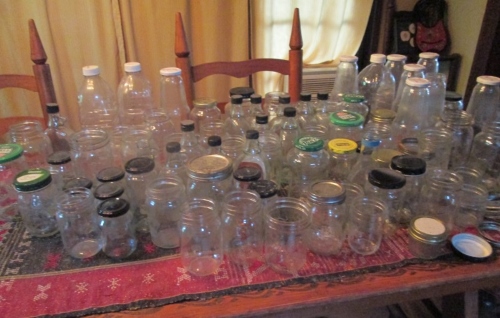
This technically isn’t much, but the reason I consider this mild hoarding is because some of these jars do not “qualify” for any of my solid reasons for keeping jars:
- canning (wet or dry)
- emergency water storage
- flower vases
- gifting small stashes of things, like a jar of m&ms or jellybeans
for a neighbor-child - some “beloved jars” are just nostalgic, rare, or simply beautiful in design
I have no other reasons for keeping jars. Jars that have lids with writing on them do not serve any of my purposes. Lids must be solid in color, no brands. Bland jars of odd shapes with a missing lid are useless. I even had a few plastic jars, which are utterly useless, unless they are extra-large for water storage.
So I sorted them all out and it looked like this (coffee mug as a gentle reminder to enjoy the process):
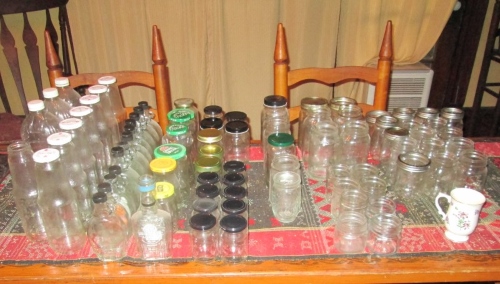
Far left: water jugs, now filled and in the basement.
Next to them, the tall jars are great as flower vases, and I grow a lot of flowers and like to gift wildflowers.
The column of maple syrup jars: I intend to purchase vodka and fill these. It will be good for bartering or even for medicinal purposes.
The eclectic column went into the trash.
The jars with lids of black or gold are to be filled with probably jellybeans: a treat for my son or anyone in need of an emotional lift.
The sparse column of jars beside them are my “beloveds,” which are now on my kitchen countertop to make their way into my Extended Pantry so I can smile when I see them.
The rest to the right is a mix of Mason jars and generic jars. I threw out all that would not seal with a Mason-style lid (the typical wide or narrow) and kept the rest. The less sturdy (non-Mason-style) jars can be used for dry-canning or foods that do not require pressure-canning.
My laundry/storage room no longer feels hoarded, but prepped. It now reflects a rhythm of readiness—a space where jars are not just containers, but part of the art of sanctuary. Each shelf holds intention. Each item has a future. And in this three-square-foot section of my home, I feel the difference between accumulation and sanctuary stewardship.
Prepping, for me, isn’t about fear, but about tending to thresholds—seasonal, maternal, metabolic—with foresight. It’s about knowing that what I store today may nourish someone tomorrow, and that comforts my heart.
Whether it’s a jar of jellybean-upliftment, a bottle of vodka tucked away for barter or tincture-making, or a beloved “Old School” jar that simply makes me smile—this is how I prep: not to survive behind barred doors, but to lean into trust and live more open-heartedly, hopefully always with enough to share.


Leave a comment